
Industrial wastewater management in the United States is changing quickly. Companies are under growing pressure to control discharge quality, reduce freshwater dependence, improve plant efficiency and manage increasingly complex wastewater streams.
That is changing what industries expect from wastewater treatment companies USA businesses work with.
Choosing a treatment partner is no longer simply about installing a wastewater treatment plant and meeting an outlet parameter. Industrial buyers increasingly look for partners that can understand their wastewater chemistry, engineer the right treatment train, support water reuse and help improve long-term operating performance.
So, what actually separates a capable wastewater treatment provider from an ordinary equipment supplier?
What Defines Leading Wastewater Treatment Companies USA?
Strong wastewater treatment providers usually have one thing in common: they design around the problem rather than forcing every project into a standard system.
Industrial wastewater can contain suspended solids, oils, organic matter, dissolved salts, nutrients, metals and process-specific contaminants. The concentration of these pollutants may also change during production cycles.
A capable wastewater treatment company therefore needs to evaluate influent characteristics, discharge requirements, recovery targets, plant footprint and operating conditions before recommending technology.
This is where engineering depth becomes important.
A well-designed treatment strategy may integrate physical separation, chemical treatment, biological processes, membrane filtration and advanced polishing rather than relying on one technology to solve every challenge.
Innovation Is Moving Beyond Basic Wastewater Treatment
For years, industrial wastewater management focused primarily on meeting discharge standards. That remains essential, but many industrial facilities are now asking another question: how much of this water can we recover?
This shift is influencing the design of modern wastewater treatment systems.
Treatment plants are increasingly being designed not only to remove contaminants but also to create opportunities for recycling and reuse. Depending on the required quality, treated wastewater may potentially support cooling, washing, utilities or selected industrial processes.
For water-intensive industries, this changes the economics of wastewater treatment.
Instead of viewing wastewater purely as a disposal problem, companies can begin evaluating it as part of the broader water balance of the facility.
Key Technologies Shaping Industrial Wastewater Treatment
Different industries generate very different effluent streams. There is no universal treatment configuration that works for every facility.
However, several technologies are playing an increasingly important role in industrial wastewater treatment.
Biological Treatment
Biological processes are widely used to reduce biodegradable organic pollutants present in industrial and municipal wastewater.
Depending on wastewater characteristics, treatment strategies may include conventional biological systems, moving bed processes or membrane bioreactors.
The right biological process can significantly influence outlet quality, sludge production, footprint and downstream treatment requirements.
Membrane Filtration
Membrane technologies have become central to wastewater recycling and reuse.
Ultrafiltration can help remove suspended particles and microorganisms, while reverse osmosis can provide further reduction of dissolved contaminants where higher-quality recovered water is required.
Membranes are particularly valuable when a wastewater treatment plant is designed with reuse as part of the original project objective rather than an afterthought.
Advanced Oxidation
Some wastewater streams contain difficult-to-degrade organic contaminants that conventional biological treatment may not adequately address.
Advanced oxidation processes can support the treatment of such complex pollutants and may be integrated as a polishing stage where required.
Ion Exchange
Ion exchange technology can provide selective removal of dissolved ionic contaminants from water and wastewater streams.
Its role becomes particularly important when facilities require specialised polishing or need to manage specific dissolved impurities that cannot be addressed efficiently through conventional treatment alone.
Water Reuse Is Becoming a Strategic Business Decision
Among water treatment companies USA industries evaluate, the ability to support water reuse is becoming increasingly relevant.
Why?
Because freshwater availability, operating costs and sustainability targets are all influencing industrial water strategies.
A factory may technically comply with wastewater discharge requirements and still lose a significant amount of usable water every day.
That is why progressive industrial facilities are increasingly evaluating wastewater treatment alongside water recovery.
The opportunity is not simply to treat water better. It is to rethink how water moves through the entire plant.
This means wastewater engineers need to understand incoming water quality, production processes, effluent characteristics, reuse possibilities and final waste streams as one connected system.
Zero Liquid Discharge Is Expanding the Recovery Conversation
For industries pursuing high levels of water recovery, Zero Liquid Discharge can become part of the discussion.
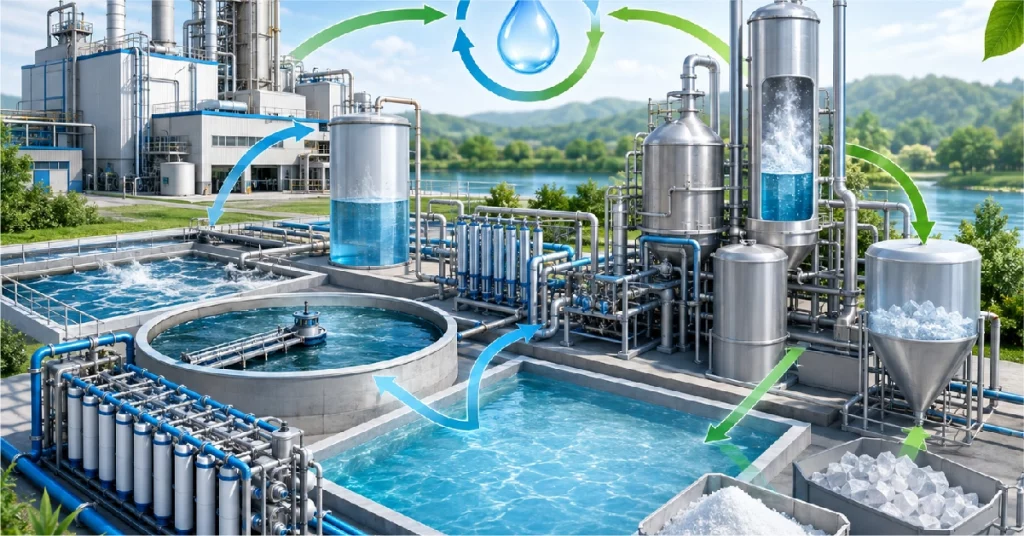
A zero liquid discharge system typically involves multiple treatment stages designed to recover water while concentrating the remaining dissolved solids.
Depending on the application, the treatment train may involve pretreatment, membrane separation, evaporation and crystallisation.
ZLD should not automatically be treated as the answer for every plant. It requires careful technical and economic evaluation.
However, where discharge constraints, water scarcity or recovery objectives justify the investment, Zero Liquid Discharge can support a much more closed-loop approach to industrial water management.
Digitalisation Is Changing Wastewater Plant Operations
Modern wastewater treatment increasingly involves data as much as equipment.
Operators need visibility into flow, pressure, water quality, membrane performance, chemical consumption and other process variables.
Digital monitoring can help engineering teams identify abnormalities earlier, analyse plant performance and make more informed operational decisions.
This matters because a treatment system does not operate under laboratory conditions.
Influent quality changes. Production loads change. Equipment ages. Seasonal conditions shift.
The real test of good wastewater engineering is how reliably the system performs when those changes happen.
Why Ion Exchange for Industrial Wastewater Treatment?
Ion Exchange brings over six decades of experience across water and environmental management, with solutions spanning water treatment, wastewater treatment, recycling, ion exchange technologies and Zero Liquid Discharge.
Its approach to industrial wastewater treatment focuses on developing treatment configurations based on the actual characteristics of the wastewater and the required outcome.
In terms of project requirements, treatment technologies can use effluent treatment, biological treatment, membrane technologies, advanced oxidation and ion exchange resins, water reclamation and zero discharge concept.
Such a capability is important for those companies that require more than one separate device.
The plant may start with just an effluent disposal requirement and later on realize the need for water reuse, capacity increase and reduced reliance on water resources. It is more beneficial to design the treatment system with such possible needs in mind.
Relevant internal linking opportunities include:
- Industrial Wastewater Treatment
- Effluent Treatment Plant
- Zero Liquid Discharge
- Wastewater Recycling and Reuse
- Ion Exchange Resins
- Membrane Technologies
- Sewage Treatment Plant
How to Choose the Right Wastewater Treatment Partner
When comparing wastewater treatment companies USA industrial facilities should begin with their own operating requirements rather than a supplier’s product catalogue.
The first step would involve outlining the characteristics of the wastewater, daily flow, changes in contaminant load, standards set for outlets, goals for the reuse process, the area available for treatment and the required space for potential expansion.
Next, check if the supplier of treatment services can offer support throughout the entire lifetime of the project.
The engineering skills of the supplier should also be checked alongside the commissioning know-how, process optimisation skills, automation expertise, and the ability to use different technologies in the process.
While a very low price can make a proposal look appealing, the economical calculations must be done for the entire lifetime of the treatment plant.
The treatment will be evaluated based on the charges for energy consumption, amounts of chemicals used, membranes that need some replacement, sludge management practices, and the costs associated to maintenance.
Conclusion
The most capable wastewater treatment companies USA industries evaluate today are moving beyond conventional treatment toward integrated water management.
The direction is clear: better contaminant removal, greater water recovery, smarter monitoring and treatment systems engineered around specific industrial requirements.
For businesses planning a new wastewater treatment plant, upgrading an existing facility or evaluating water reuse and Zero Liquid Discharge, selecting the right engineering partner can influence performance for years.
Ion Exchange combines wastewater treatment expertise with membrane technologies, ion exchange, recycling and ZLD capabilities to support complex industrial water challenges.
Connect with Ion Exchange experts to explore a wastewater treatment strategy designed around your plant, process and water recovery objectives.
Frequently Asked Questions
1. What should I look for in a wastewater treatment company?
Evaluate the company’s engineering expertise, experience with similar wastewater characteristics, treatment technologies, process guarantees, service capabilities and ability to support future water reuse or expansion requirements.
2. What are the main industrial wastewater treatment technologies?
Common technologies include screening, clarification, biological treatment, dissolved air flotation, membrane filtration, ion exchange, advanced oxidation, reverse osmosis, evaporation and crystallisation.
3. Can industrial wastewater be recycled and reused?
Yes. Depending on the wastewater quality and intended reuse application, treated industrial wastewater can potentially be reused for cooling, washing, utilities or selected process requirements after suitable treatment and polishing.
4. What is the difference between an ETP and a wastewater treatment plant?
An effluent treatment plant generally treats wastewater generated by industrial processes. Wastewater treatment is a broader term that can include industrial, municipal and other wastewater streams.
5. When should industries consider Zero Liquid Discharge?
Industries may evaluate ZLD when they want to maximise water recovery, minimise liquid discharge or respond to site-specific discharge and water availability challenges. Technical and economic feasibility should always be assessed before implementation.