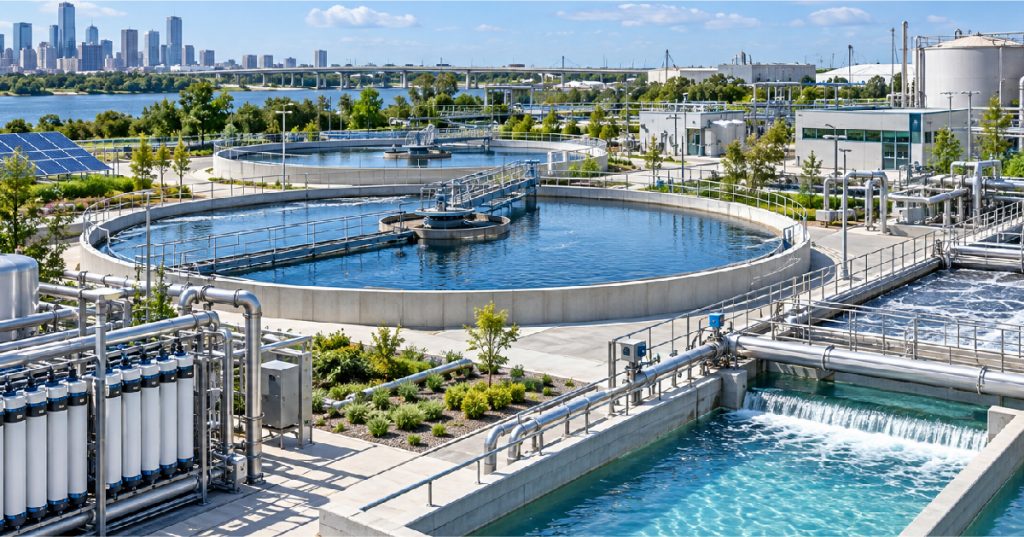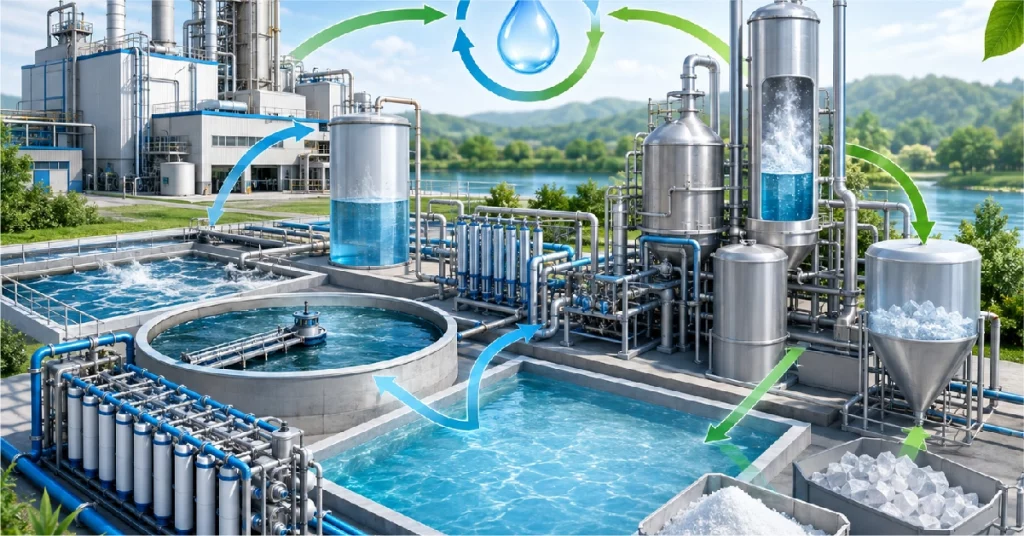

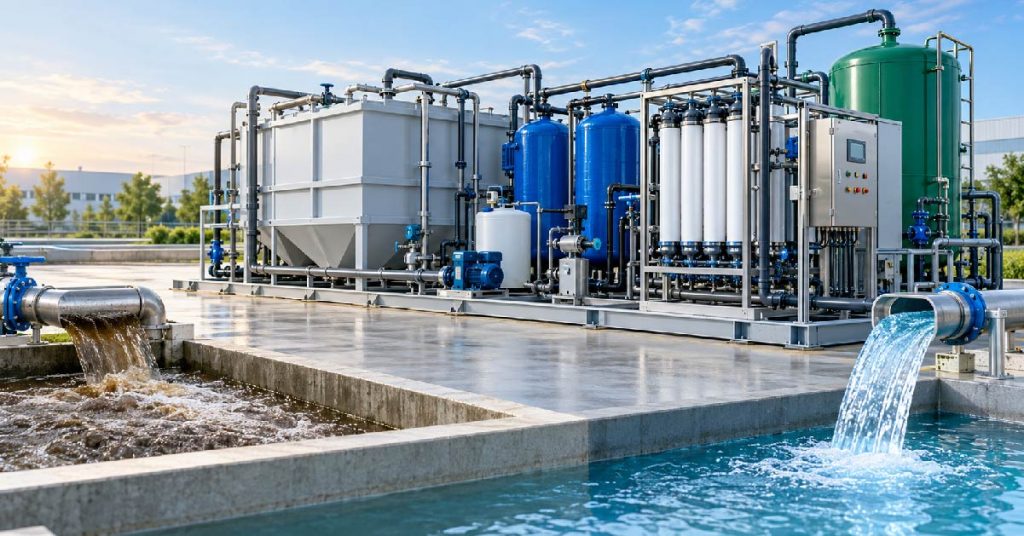
Space, construction time and operating complexity often shape sewage-treatment decisions as much as treatment capacity itself. A hotel, housing complex, resort or industrial facility may need dependable wastewater treatment without dedicating a large area to conventional civil tanks and associated equipment.
A packaged sewage treatment facility handles this issue diversely. It integrates important processes into a compact and prefabricated facility instead of building different treatment stages separately on site. This might reduce the physical footprint of the installation and make the process easier, provided that the choice of facility is made based on the actual sewage properties, the flow variability and the quality of treated water required.
What Is a Packaged Sewage Treatment Plant?
A packaged sewage treatment plant is a factory-built or prefabricated system designed to treat domestic sewage within a compact arrangement. Depending on the technology, primary settling, biological treatment and clarification may all be brought together within one modular unit.
It’s the most critical difference between packaged sewage treatment plants and traditional waste treatment plants built predominantly through civil engineering. The goal remains the same: to remove organic matter and suspended solids. However, the difference is in the configuration, installation, and operation of the treatment system.
In projects where space is limited and construction methods should be simple, this difference is vitally important.
How Does a Packaged STP Work?
Not every packaged system uses the same process, which is worth understanding before comparing suppliers.
Ion Exchange’s INDION New Generation Packaged Sewage Treatment Plant, or NGPSTP, combines lamella plate clarification with aeration in a ready-to-operate prefabricated configuration.
Primary Settlement
Sewage first enters the primary settlement section.
In the INDION NGPSTP, lamella parallel plates assist the separation of suspended matter before the sewage reaches biological treatment. According to Ion Exchange’s product brochure, this stage can reduce suspended solids by 75% and BOD by 25%.
Taking out a portion of this load early makes the following biological stage easier to manage.
Aerobic Biological Treatment
Partially clarified sewage then enters the aerator bio-zone. This section combines a fixed-film reactor with active aeration.
Microorganisms attach themselves to a solid surface and consume organic matter present in the sewage. In the INDION design, rotation of the aerator drums also introduces oxygen into the liquid. Ion Exchange states that the bio-zone is self-cleaning and does not require separate sludge-return pumping.
Final Settlement
The biologically treated water then moves into a final settlement zone.
Here, another lamella plate arrangement helps finer particles settle. Sludge is removed periodically through a submersible pump and transferred to the plant’s sludge-storage section.
It is a relatively compact treatment sequence, but the fundamentals still matter: correct hydraulic loading, suitable capacity and a realistic understanding of the incoming sewage.
Why Choose a Compact Sewage Treatment Plant?
A compact sewage treatment plant becomes particularly useful when treatment has to fit within a constrained site.
Land is, as a rule, the most obvious consideration. Large civil treatment tanks may not fit comfortably into a resort, commercial property, or residential development. A packaged configuration concentrates treatment into a smaller footprint.
Installation can also be more straightforward. Since much of a prefabricated sewage treatment plant is manufactured before it reaches a site, the extensive construction work can be reduced in comparison to a completely site-built system.
Modularity matters as well. Ion Exchange’s NGPSTP comes in modular capacities from 10 to 100 m³/day, thus giving project teams some room to choose capacity around site requirements.
Still, compact shouldn’t be confused with universal. A system that fits physically must also fit the hydraulic load.
Where Are Packaged Systems Commonly Used?
Packaged systems make particular sense where sewage is generated at a defined location but a large centralised treatment plant would be impractical.
Ion Exchange outlines applications such as hotels and restaurants, vacation resorts, golf and country clubs, townships, and residential complexes, national parks, industrial estates, and reconstruction of existing plants.
Although these applications may seem to be the same in terms of capacity, the operational behavior may differ.
Let’s take a hotel as an example. Hotel occupancy leads to the significant differences in wastewater flows of morning and evening hours. In comparison, a residential complex may have a different loading curve. This is why choosing a packaged wastewater treatment plant should not be based only on daily-flow average numbers.
What Should You Check Before Selecting a Packaged STP?
Capacity is the starting point, not the full specification.
Estimation of sewage flow characteristics has to be performed as a first step by the project teams. Tracking the wastewater quality parameters is also of great importance. It includes BOD (the biochemical oxygen demand), COD (the chemical oxygen demand), OS (the suspended solids), and, when appropriate, contents of the nutrients.
Next, the necessary quality of the effluent must be determined as clearly as possible. The treatment process may differ in accordance with whether the plant is built for discharging water in the environment or treating it for reuse.
Other aspects such as the presence of the space for any kind of O&M (operations and maintenance), access, electricity supply and sludge removal, also matter. The question of maintenance is also important, though it is often given much less attention in practice.
Even a compact type of plant is to be inspected, unloaded and maintained. This being said, the importance of the maintenance might not be less than that of the equipment which is used within the treatment process as soon as the plant starts to work.
Packaged STP vs Conventional Sewage Treatment Plant
There is no useful rule saying one format is always better.
A standard sewage treatment plant is suitable for major flows, bespoke treatment processes, or situations where civil engineering and land availability are not a concern.
Packaged systems apply when there is a need for a smaller sized plant, modular arrangement, or easier installation.
This means that the word prefabricated sewage treatment plant cannot be viewed as a “ready-made product.” Some engineering work has to be done to match the plant with the flow variations, treatment requirements, operational conditions, and future needs.
Thus, the most relevant comparison is not packaged vs. conventional, but the best choice with regard to the price-performance ratio at the specific location.
What Makes Ion Exchange’s NGPSTP Different?
Ion Exchange describes its INDION NGPSTP as an all-in-one, single-tank packaged system combining lamella clarification and aeration. The design is modular from 10 to 100 m³/day and is intended to provide a compact, easy-to-operate sewage-treatment solution.
The brochure also highlights three months of sludge-storage capacity, minimal maintenance and a GRP tank construction designed to avoid corrosion. Listed advantages include minimal land usage, lower power and chemical requirements and reduced operating cost.
More importantly, Ion Exchange does not rely on a single packaged technology for every sewage-treatment requirement. Its wider portfolio includes Fluidised Media Reactor systems, Sequencing Batch Reactor systems and membrane-based treatment options alongside NGPSTP.
That gives project owners the option to match the process to the treatment requirement rather than force every application into one technology.
Final Thoughts
A packaged sewage treatment plant can be a practical answer where dependable sewage treatment has to coexist with limited space, construction constraints and the need for manageable operation.
But the word “packaged” should never remove engineering from the decision. Flow fluctuations, wastewater strength, effluent targets, sludge handling and future capacity all influence whether the system will continue to perform after commissioning.
If you are planning a new packaged STP, replacing an ageing sewage treatment plant or assessing a decentralised wastewater solution, connect with Ion Exchange experts to evaluate the site conditions and identify a suitable treatment configuration.
FAQs
Is a packaged sewage treatment plant suitable for a small site?
Yes. Its compact and modular configuration can make it suitable where available land is restricted. Capacity and technology should still be chosen according to actual sewage flow and treatment requirements.
What is the difference between a packaged STP and a conventional STP?
A packaged system integrates major treatment stages within prefabricated equipment, while a conventional plant may depend more heavily on site-built civil tanks and individually constructed process units.
Can treated sewage from a compact sewage treatment plant be reused?
It can be, provided the treated-water quality meets the requirement of the intended reuse application. Additional treatment or disinfection may sometimes be necessary.
What is a prefabricated sewage treatment plant?
It is a sewage-treatment system in which major process units and tankage are manufactured before installation at the project site, reducing the amount of construction required there.
How should I select a packaged wastewater treatment plant?
Start with average and peak flow, wastewater characteristics, required outlet quality, available space, power requirements, sludge handling and maintenance needs. The treatment technology should then be selected around those conditions.