An AI data center can have backup power, redundant servers and advanced cooling equipment, yet still face an operational risk from something as basic as water availability. As computing loads increase, cooling systems must remove more heat without compromising equipment reliability. Ion Exchange supports industrial water treatment and recycling requirements through solutions that can form part of a broader data center water management strategy. For operators planning AI infrastructure, the challenge is not simply securing enough water. It is making sure the cooling system receives water of the right quality, in the right quantity, whenever it is needed.
That becomes particularly important in regions facing seasonal water shortages. A cooling system may perform perfectly under normal conditions, but what happens when water quality changes or the available supply falls during peak summer?
Why AI Is Changing Data Center Water Requirements
Cooling requirements in conventional server installations are already significant, and AI applications present a further challenge: they are producing more computing power in equipment racks that are growing increasingly dense.
More heat has to be extracted from a small area.
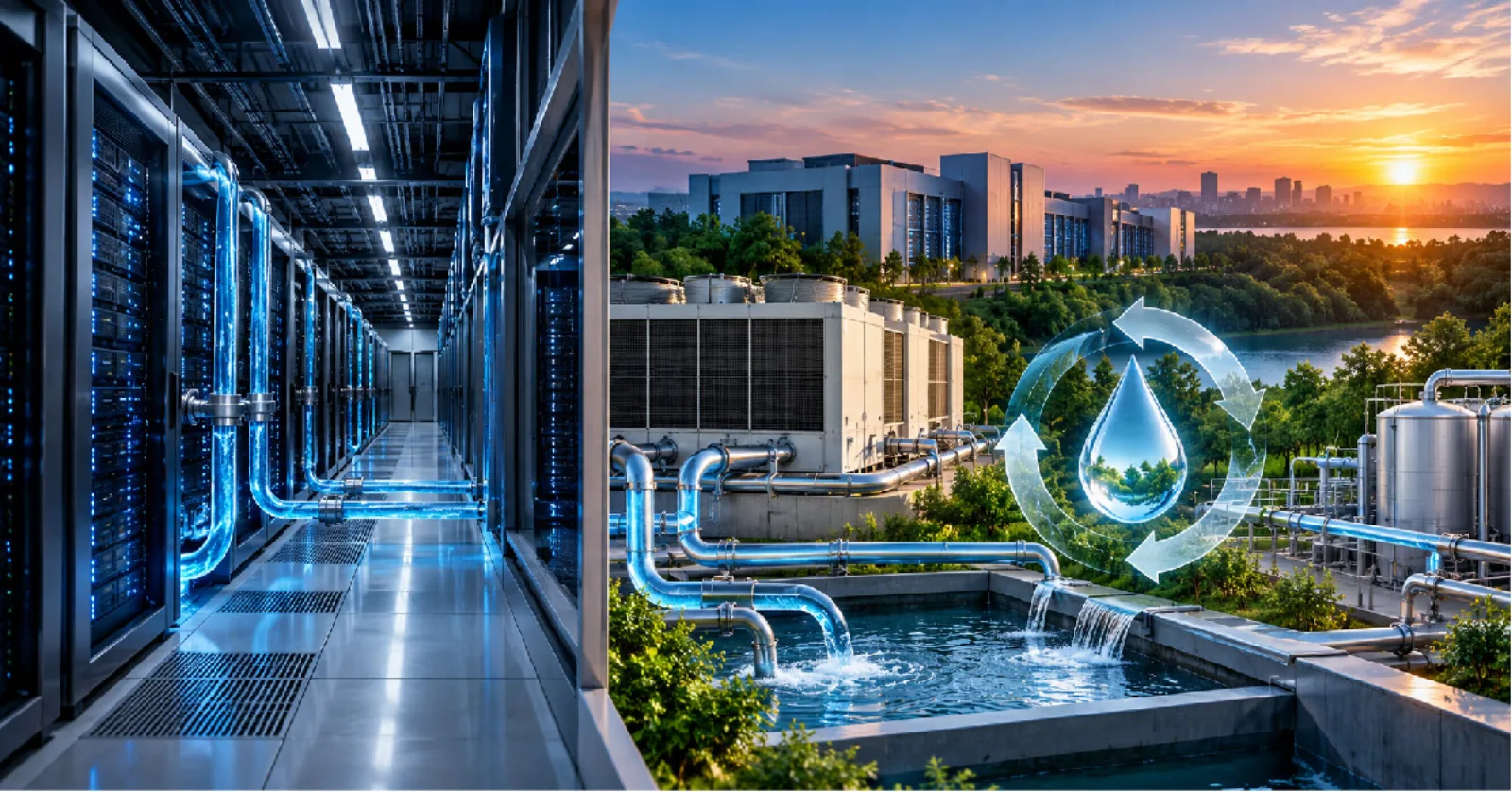
As a result, operators are taking a look at liquid cooling methods in addition to traditional ones. One example is direct-to-chip cooling, which involves channeling liquid through chips instead of just using ambient air to carry heat away.
However, the question of water usage is less straightforward as far as liquid cooling is concerned.
A closed-loop liquid cooling setup can be capable of reusing the same liquid multiple times.
What will matter much more is how to handle the heat afterwards.
In data centers, the choice of cooling technology between evaporative towers and dry coolers is crucial as it determines water and power consumption.
The correct option depends on the ecosystem, computing density, thermal requirements, and reliability objectives.
Where Does a Data Center Actually Use Water?
Cooling towers are a major source of direct water consumption in facilities that use evaporative cooling.
As warm water circulates through the tower, a portion evaporates and carries heat into the atmosphere. The remaining water becomes more concentrated with dissolved minerals.
To control this concentration, some water is discharged as blowdown and replaced with fresh makeup water.
That creates two separate requirements: a reliable makeup-water supply and appropriate treatment of the incoming water.
Other systems may use water for humidification or supporting utilities, although the quantities vary by facility design.
Understanding these demands is the first step in effective water management for data centers.
A facility using predominantly dry cooling will have a different water profile from one relying heavily on evaporative heat rejection.
Why Cooling Water Quality Matters
The cooling efficiency relies on other factors apart from the availability of water.
Water that has not been treated or heavily managed has the ability to cause problems such as corrosion, scaling or the development of biofilms.
The presence of salts in water leads to deposits on heat transfer surfaces. Corrosion affects pipes and equipment. Biofouling may disturb the flow as well as heat transfer efficiency.
These issues have the potential to cause drops in efficiency over time.
Let us take a cooling system which has to operate under conditions where heat exchangers are increasingly fouled. In this case, the equipment will need to exert more efforts to eliminate the same amount of heat, thus consuming more energy and involving more maintenance.
Therefore, water chemistry has to be taken into consideration during the design phase of any cooling system rather than in commissioning.
Data centers should use an effective water strategy for cooling and treat the water depending on its source and equipment needed.
For closed liquid cooling systems coolant specifications have to be clearly stated and these have to meet the requirements of the cooling equipment rather than any other presumptions concerning cooling systems.
Can Data Centers Reduce Freshwater Consumption?
Yes, although the opportunities depend on the cooling technology and local water conditions.
For evaporative cooling systems, one option is improving cycles of concentration.
As water evaporates, minerals accumulate in the circulating water. Blowdown removes some of those minerals to maintain acceptable chemistry.
Increasing the number of cycles can reduce blowdown, provided scaling, corrosion and microbial risks remain controlled.
Another possibility is using alternative sources of makeup water.
Municipal reclaimed water, treated industrial wastewater or recovered facility water may be suitable after appropriate treatment.
This is where water reuse becomes valuable.
However, reclaimed water should never be introduced directly into sensitive cooling systems without checking its composition.
Dissolved salts, nutrients, organic matter and microbial quality all influence the treatment required.
Water Reuse Needs More Than a Recycling Plant
A treatment system may produce excellent water during commissioning and still struggle when the incoming wastewater changes.
That is why reuse planning should begin with a realistic understanding of source-water variability.
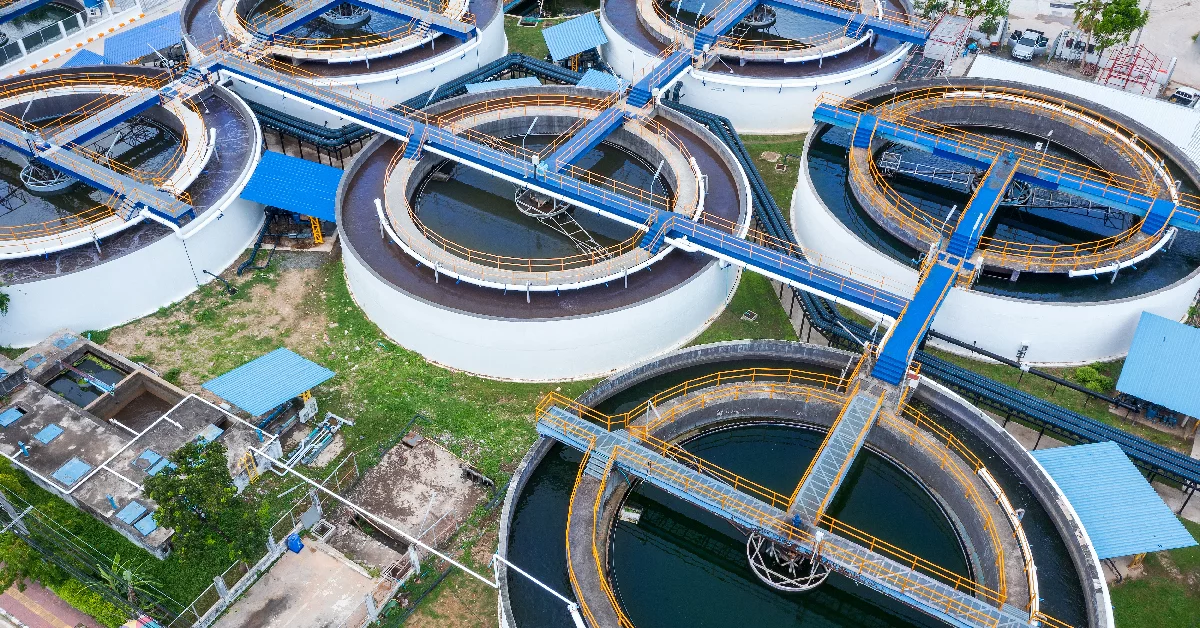
Depending on the application, treatment may involve clarification, biological processes, ultrafiltration, reverse osmosis or disinfection.
The objective is to produce water that meets cooling-system requirements consistently.
For facilities considering water reuse, storage and supply arrangements are also important.
If reclaimed water becomes temporarily unavailable, can the cooling system switch to another approved source? Is there sufficient storage to manage short interruptions?
These questions connect water treatment directly with uptime planning.
Planning Water Supply Around Uptime
It is important to note that the cooling systems in a data center cannot be switched off while the plant serves its maintenance purpose. As a result, reliability is of utmost importance.
In addition, critical pumps, treatment systems, instruments, and control mechanisms need to have redundancy. The maintenance process should provide for the ability of the critical systems to be serviced without creating problems with maintaining the necessary water flow.
Water storage can help overcome short breaks. However, the necessary water amount is determined by the cooling requirements and the time when the problem occurs.
The operators must understand their standard water use and possible emergency situations in terms of water supply in order to organize proper water control for their data centers.
Thus, the cause of the problem may be the malfunctioning makeup-water pump, as well as the instant drop of the quality of the source water, the failure of the membrane system, or any problems in the city water supply.
In addition, monitoring is very important. The process of monitoring can help define anomalies in the processes, including flow, pressure, density, and tank level indicators.
Measuring Water Efficiency Alongside Energy
Water efficiency should not be assessed separately from electricity consumption.
One commonly used metric is Water Usage Effectiveness (WUE), which measures annual site water consumption relative to the annual energy used by IT equipment.
A lower WUE generally indicates lower direct water consumption per unit of IT energy.
However, WUE alone does not explain the complete environmental or operating impact.
A dry cooling system may consume little onsite water while requiring more electricity under certain conditions. Evaporative cooling may offer an energy advantage but consume more water.
The appropriate choice depends on local climate, energy costs, water availability and operational requirements.
A well-planned data center cooling water strategy should therefore evaluate water and energy together.
Simply reducing one metric does not necessarily improve the overall system.
Why Water Security Should Be Considered Before Expansion
Imagine a facility planning to double its computing capacity.
The immediate engineering discussions may focus on electrical infrastructure, cooling equipment and available space.
But will the existing water supply support the expanded cooling load?
If the facility depends on groundwater or municipal supply, seasonal availability and future demand should be examined before expansion begins.
Alternative water sources may require additional pipelines, treatment equipment or storage. These projects can take time to develop.
The economics matter too.
Operators should consider freshwater purchases, treatment chemicals, electricity, blowdown management and maintenance when evaluating the complete cost of data center water.
In some locations, a hybrid cooling arrangement or recycled-water supply may improve long-term resilience even if the initial investment is higher.
How Ion Exchange Supports Data Center Water Management
Ion Exchange provides solutions for water and environmental management, including raw water treatment, filtration, softening, reverse osmosis, industrial wastewater treatment, recycling and reuse.
These technologies can help meet water quality and recovery needs related to cooling systems in data centers.
As an illustration, one facility may require treatment for its cooling-tower feedwater to eliminate hardness and dissolved salts.
Another facility may want to turn to reclaimed water as a water source instead of fresh water.
Ion Exchange is able to evaluate what characteristics the water source has and what treatment solution will be effective.
Moreover, the company's know-how in the area of monitoring, automating and maintaining processes may help provide reliable water treatment operation.
The focus should remain on making sure treatment process fits the cooling facility, which means that not every data center would need the same treatment configuration.
Reliable Cooling Begins With a Reliable Water Strategy
AI infrastructure is increasing the importance of cooling performance, but managing heat is only part of the challenge.
Water availability, treatment quality, recycling potential and supply reliability can all influence how consistently a facility operates.
Effective data center water management brings these considerations together before they create operating difficulties.
For operators planning new AI facilities or upgrading existing infrastructure, the priority should be a practical balance between cooling efficiency, water reuse, energy consumption and uptime.
Planning a new data center or reviewing your existing cooling-water infrastructure? Connect with Ion Exchange to explore treatment, recycling and water-management solutions suited to your facility's operating requirements.
Frequently Asked Questions
1. Why is water management important for AI data centers?
AI data centers can generate significant heat that requires dependable cooling. Water management helps ensure suitable water quality, consistent supply and efficient cooling-system operation.
2. How can data centers reduce cooling water consumption?
Depending on system design, operators can improve cooling-tower cycles of concentration, optimise operating conditions, consider dry or hybrid cooling and use appropriately treated reclaimed water.
3. Can data centers use recycled water for cooling?
Yes. Reclaimed municipal or industrial water may be used for suitable cooling applications after treatment. The required quality depends on the cooling equipment, water chemistry and operating conditions.
4. What should a data center cooling water strategy include?
A data center cooling water strategy should address source-water reliability, treatment requirements, cooling technology, makeup-water demand, reuse opportunities, monitoring and backup supply arrangements.
5. How does water quality affect data center uptime?
Poor water quality can contribute to scaling, corrosion, fouling and reduced heat-transfer performance. Appropriate treatment and monitoring help limit these risks and support reliable cooling operations.